



Bill 21 in the Supreme Court of Canada: EMSB defends the constitutional rights of official language minorities and women
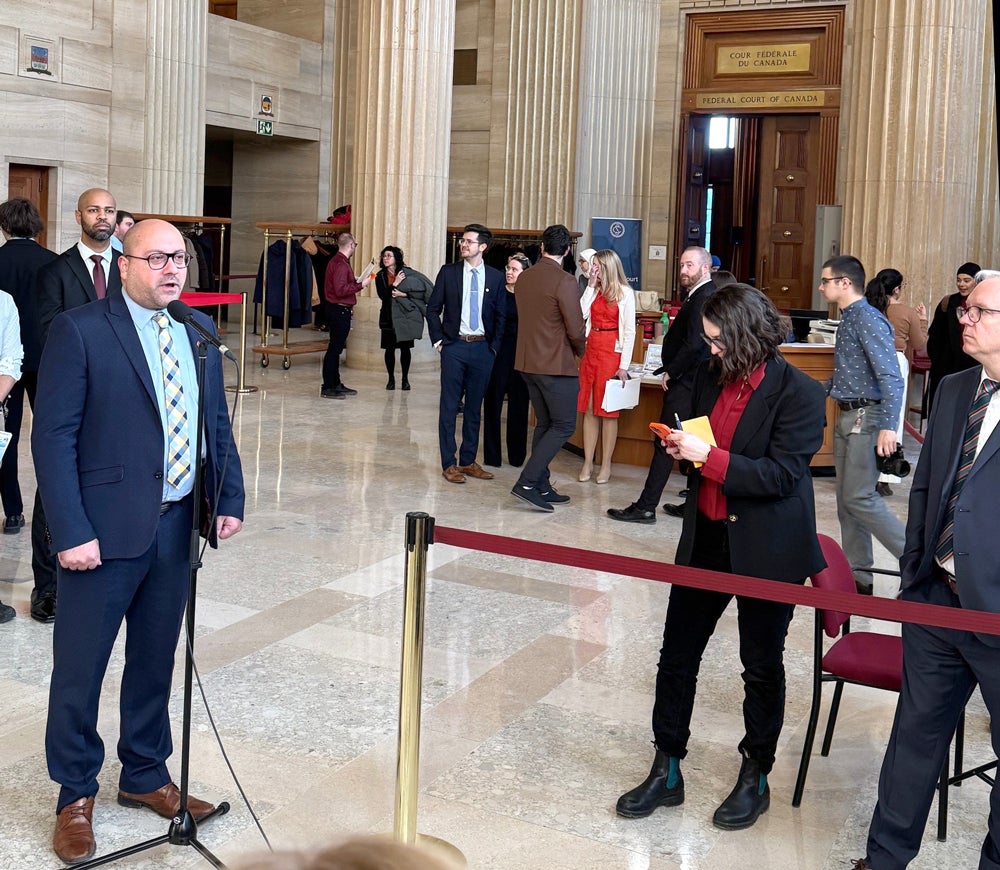
The English Montreal School Board made representations on the unconstitutional nature of Québec’s Bill 21, An Act Respecting the Laicity of the State, before the Supreme Court of Canada. The EMSB’s submissions focused on minority language education rights and gender equality.
The EMSB challenged Bill 21 in the Québec Superior Court in 2020. The legislation has barred the EMSB from hiring qualified teachers who wear religious symbols while at work (overwhelmingly, Muslim women wearing the hijab). The Québec Superior Court agreed with the EMSB and struck down key provisions of Bill 21 in April 2021 (the only successful challenge to the Bill at first instance). However, the Québec Court of Appeal overturned that decision in February 2024. The EMSB, along with other parties, successfully sought leave to appeal that ruling to the Supreme Court of Canada.
“Today, we had the opportunity to explain to the Supreme Court of Canada how Bill 21 conflicts with our values and our mission and with those of all Quebecers, as expressed in the Québec Charter of Human Rights and Freedoms,” stated EMSB Chair Joe Ortona. “Its very adoption was contrary to our societal goal of promoting peaceful coexistence in a pluralistic, secular Québec.”
Bill 21 prohibits those wanting to become primary or high school teachers, school principals, and vice-principals from wearing religious symbols, prohibiting any career advancement for current employees unless they remove any and all visible religious symbols, no matter their personal, cultural, or religious significance. In practical terms, Muslim women have not simply been the main group targeted by Bill 21—every documented case of termination under Bill 21 has involved a Muslim woman teacher. But, as Mr. Ortona explains, “most worrisome is the message of intolerance and exclusion Bill 21 conveys to our students and their families. Our students’ ability to thrive has been jeopardized, notably (but not only) for religious minorities. We are proud that we forcefully made that point in front of the highest court in the country, both in writing and, today, in oral submissions.”
The EMSB’s legal submissions are based on section 23 of the Canadian Charter of Rights and Freedoms, which guarantees minority language educational rights to the English-speaking minority in Québec. Section 23 protects the exclusive right of the English-speaking community to manage and control its school boards in accordance with its linguistic and cultural values.
“Respect of the personal and religious rights of our students and staff, which are guaranteed both by the Canadian and Québec charters of rights, is a deeply-held value at the EMSB” said Mr. Ortona. “Bill 21 runs roughshod over what we teach with regard to respect for individual rights and religious freedoms.” The Superior Court of Québec sided with the EMSB in respect of section 23 of the Canadian Charter, but this result was overturned by the Québec Court of Appeal.
EMSB’s challenge to Bill 21 is also based on gender discrimination, prohibited under section 28 of the Canadian Charter. This is the first time the Supreme Court of Canada will have the opportunity to pronounce itself on this significant and less well-known section of the Constitution. Section 28 is engaged, explained Mr. Ortona, because, “due to the preponderance of women working in Québec schools, the law has a disproportionate effect on them, particularly Muslim women”.
The Supreme Court will continue to hear oral arguments from other parties and interveners until Thursday, at which point the EMSB will have the opportunity to make a short reply. This is one of the longest hearings in the Supreme Court of Canada’s history—and is the single hearing with the most governmental and civil society interveners in Canadian history—signaling its significance to Canada’s social and legal landscape.
About the English Montreal School Board
With a youth and adult sector population of more than 33,000 students, the English Montreal School Board (EMSB) is the largest English public school board in Québec. Established in 1998, when the province restructured school boards along linguistic lines, the EMSB network now consists of 73 schools and centres. For more details, visit the EMSB website at https://www.emsb.qc.ca.